
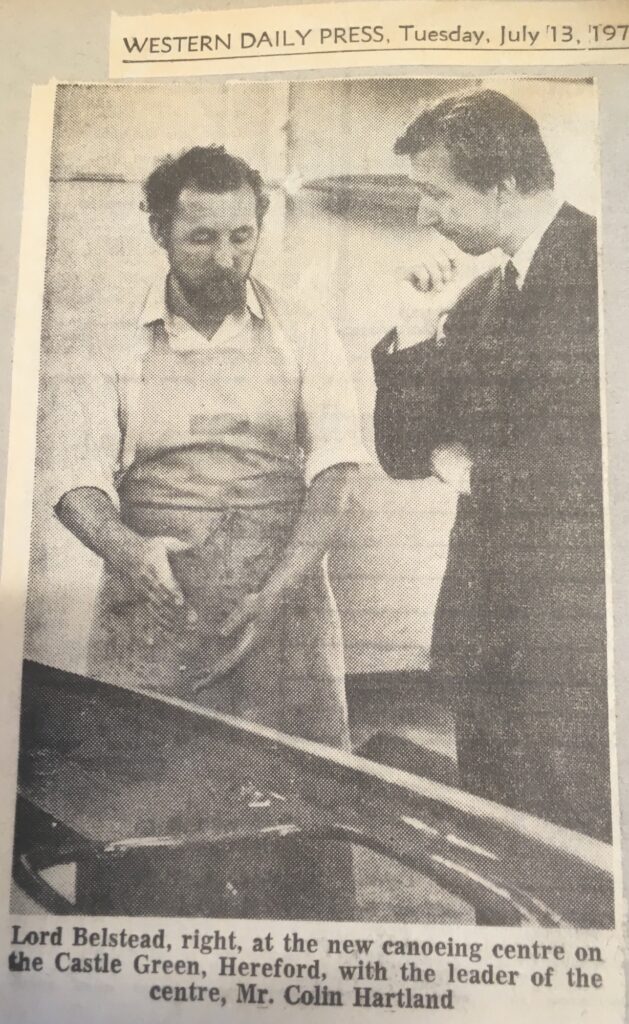
– Tuesday July 13, 1970
There can be occasions and areas paddling down the Wye, when one has to jostle for space because of the sheer number of canoeists, especially at particular ‘honey hotspots’. There’s no doubt, canoeing is big business. There are of course stretches that still allow for a gentle saunt downstream and these are to be valued.
For a western audience, canoeing is a relatively new vessel. We were far more accustomed to the rowing boat or even the humble coracle than we ever were to the canoe. Scottish explorer John MacGregor should be thanked for introducing us to the canoe. He first encountered it on a trip to North America in the 1850s. On his return to Britain he designed a 4.6-meter craft based on the Native American canoes he had paddled on his travels. Constructed from oak planking and covered with rubberized canvas, the boat had an open cockpit and was powered with a double-bladed oar. His book, A Thousand Miles in the Rob Roy Canoe, brought the craft, and the activity, to a European audience. Fast forward 150 years and canoeing on the Wye has really taken off.
One of the early canoeing holiday pioneers on the River Wye was Peter Gordon Lawrence (died 2004). An experienced canoeist, he had negotiated many European rivers in the 1950s before settling on the Wye as the ideal base for his holiday idea. His advertising in the early days of the business promised ‘waterproof top jackets, dining marquee, and hutted ablutions!’ From its former base in sleepy Hole in the Wall, outside Ross-on-Wye, Peter built PGL into a huge international organisation. The Wye’s navigational rights, and the sublime countryside of course, were huge bonuses. Kenneth Johnson, a friend of Peter’s, was on one of their early Wye voyages. He wrote in his diaries at the time in the early 1960s:
‘Maybe you have never experienced the thrill of canoeing down the Wye through the peaceful English countryside. I could tell you about the stormy night at Symonds Yat and waking in the morning to watch the opposite bank creeping upwards into the sunlight; or of a paddling across the river to fetch the morning milk at Weirend. Or I could tell you about the various short, steep excursions to shops and a castle and Yats. I could tell you so much.’
By the mid-1960s youth clubs along the river’s route were beginning to embrace the canoe. But these were the days before one could buy a canoe ‘off the shelf’. Hunderton Youth Club made theirs, constructing a timber frame and stretching canvas over it, before covering it with a bitumen-like concoction. Canoes made, it was not unusual for youngsters to go off down the Wye for adventures, ever vigilant for rocks in the water that might rip the canvas.
In 1971 the Hereford Canoe Centre opened at the Pavilion on Castle Green and Derek Evans was on hand to record the event for local news networks. The Centre’s Colin Hartland welcomed their special visitor, Lord Belstead, an undersecretary in Thatcher’s education team in Edward Heath’s government of 1970. Governments have come and gone in the nearly 50 years since the centre opened, but it is still going strong, providing an excellent service to the young people of Hereford.
Born and bred a Herefordian, Vic is the stalwart behind the Hereford Canoe Centre on Castle Green today. He is passionate that this youth club continues: ‘You need places like this to pass the knowledge on to young people.’ He worked at the General Hospital as an engineer for 42 years before his retirement:
‘I’ve spent my life on the river. My house was by Hunderton Youth Club and you could be in the river in three minutes. We all used to swim in it as kids. Our parents never warned us, there was no health and safety then; the river was your playground. You’d either go up to the woods, or you’d swim in the river in the summer, or you’d camp out by the river in the summer at Belmont. We would just go home after a week. You’d go up there, pitch your tent and just get on with it. Either fish, swim, or canoe, it was your life then.
‘In 1958, I was at Hunderton Youth Club and we started to make canvas boats. It was cheaper to make one than buy one then and there were fewer canoes on the river in those days. There was a guy called Percy Blandford who drew up the drawings of the skeletons of the boat and we made them up with plywood. And then you wrapped them in canvas and held that down with copper tacks.
‘We launched just by Hunderton ferry. We would do just the Belmont Stretch at first and then we started to get a bit more adventurous when I was 15 or 16 and we started to go up to Glasbury and stop at Preston-on-Wye overnight, and stick the tents up.
‘We first tried them at Preston-on-Wye at the campsite. Basically, you got out of your kayak, got on top of the bank, put your tent up, which was excellent, a form of a bell tent and could sleep four or six easily. Then we would get the timber and start a fire and cook over the fire. There were no gas fires then, you just did the best you could. We could get quite a bit of kit in our canoes. We built four of them in the end. In those days, you would pack your kayak and off you’d go and if you forgot something that was it for the next few days: you couldn’t do anything about it. And we would have just one adult with us, Bruce Ruderford. But it’s all changed these days.’
Those were the days, eh?
– Marsha O’Mahony